
In February of 2026, Winter Wheat, a real estate development and consulting firm, presented Louisville Community Grocery owners with comprehensive research, case examples, and partner insights to determine how to move forward sustainably. Here is the second of three case studies chosen for the presentation from over 30 co-ops studied nationwide based on location, scale, population served, and demographic data.
Category: Coop Info
-

New Projects Brewing
At our March 19th owners’ meeting, a small group of Louisville Community Grocery (LCG) owners volunteered to explore ways that LCG could start selling groceries before we build a store. One way is a “buying club,” which has a small space for receiving, storing, and distributing food but
not an actual storefront. For example, a buying club might accept food orders from its members every Wednesday (in person or online) and distribute the food on Friday. A buying club usually serves only its member-owners, and not the general public. Starting a buying club could be a
low-cost, low-risk way for LCG to grow into a full-service grocery store. It would help us learn the items to stock in the store, the payment methods that our community prefers, and other things that will make our owners and community members happy to shop at LCG.The LCG Buying Club Working Group is putting together a proposal to bring to the LCG Board for approval. We would start the buying club as an experiment, with the intention of improving and expanding it as we go. We will ask for your suggestions and concerns every step of the way. To help us get started, please answer a quick 2-question survey. Thank you!
If you would like to join the LCG Buying Club Working Group, please contact Arte Chambers at LouisvilleCommunityGrocery@gmail.com. -
Why has it taken so long to open the Louisville Community Grocery?
Our co-founders began meeting in the Portland neighborhood in the fall of
2015 and founded LACE in 2017. Organizing meetings moved around
neighborhoods as they wanted to connect with residents who had been
affected by recently closed grocery stores (from 2016 to 2018, five stores
closed within the Watterson/city core), then landed in Russell for a while. We
incorporated the LCG in 2019 and kicked off a soft launch owners campaign. We organized into committees with LACE members to conduct the work of
our co-op. COVID-19 affected our ability to host our monthly in-person
owners’ meetings, and we didn’t return to that. Nevertheless, the work
continued.Over the fall of 2021 and spring of 2022, we secured philanthropic funding
for LACE and predevelopment activities, land from the Community
Foundation of Louisville, and a $3.5M bond issuance from Louisville Metro
Government. Co-founder of LACE and LCG, Cassia Herron, resigned as
LACE’s board chair in the fall of 2021 and soon after, LACE hired executive
staff to oversee its mission, and the two entities began having problems.LACE did not follow the plans Herron left to guide the efforts to develop the
land, build the business, and engage residents and owners in the process, and began going at the work alone. By 2023 the relationship between our co- op’s leadership and LACE had completely fallen apart and officially ended in
2024.
In 2024, our newly elected board and a handful of owners worked to regain
access to the co-op’s assets created with LACE that LACE retained control
of when the partnership dissolved. We conducted an updated market study
that maintained the property at Finzer was still the best property to pursue for
our store (along with a Louisville Metro Housing Association property in
Russell). In 2025, we learned that the Finzer site was acquired by the
Smoketown Community Land Trust. When we approached them about
building our grocery store there, they indicated they were not yet ready to
make a decision about how to use the property.
In 2025, LCG was awarded a grant for research regarding our future site. This
research was completed and shared with the LCG ownership at the February
2026 Owners Meeting. We are currently considering options for how to move
forward. -
Where will the grocery store be located?
February 17, 2026
As a reminder, the Finzer site that LACE was gifted on our behalf is now in the possession of REBOUND who will gift the property to the Smoketown Community Land Trust (SCLT). We have spent the last year exploring a partnership with the SCLT and a few months ago learned the SCLT has leased the Finzer site to a construction company over the next two years and is not prioritizing developing the site at this time.
We secured funding from The Reinvestment Fund’s Healthy Food and Financing Initiative recently to explore partnerships and development opportunities. We contracted with MK Lindsey, a local development consultant, who conducted some very timely research on a number of other co-ops as well as site leads. At the February 19th, 2026 Owners Meal and Meeting, the LCG Board will present on her report and engage owners about a way forward.
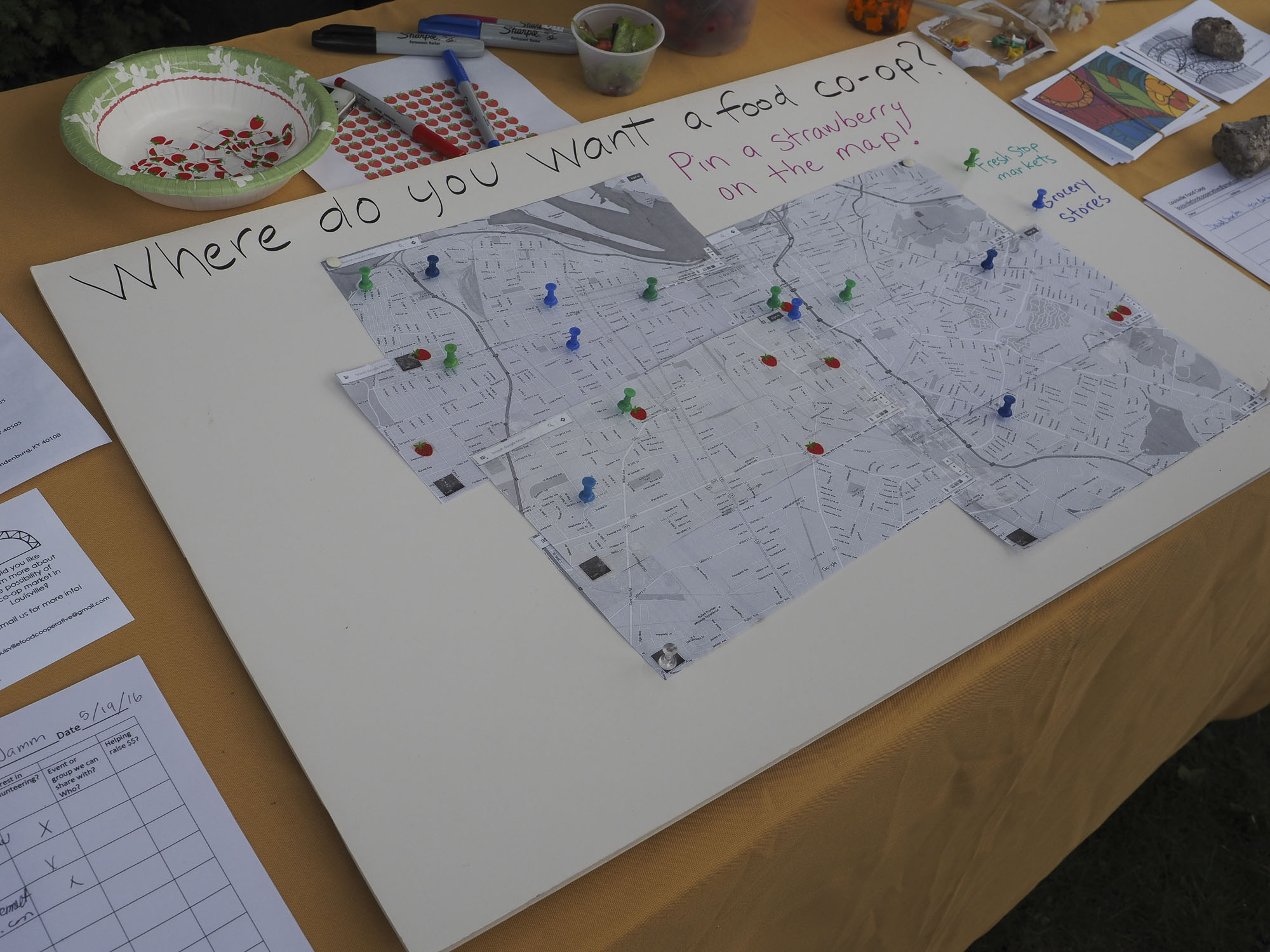
Over the course of our organizing, we have considered over two dozen properties in Old Louisville, Smoketown, Shelby Park, Russell, Portland, Shawnee and Parkland. These neighborhoods were chosen due to the food access needs and the residents’ interest in cooperative economics, demonstrated by their participation in New Roots’ Fresh Stops. Two market studies (2020, 2024) were conducted. The search in both studies identified properties with the best potential in Smoketown and Russell.
We are in the process of deciding, and that’s where our Owners come in. Ultimately, it will be through a vote of the Owners that the destination is decided.
-

What is an LCA?
Why is Louisville Community Grocery set up as an LCA?
An LCA is a Limited Cooperative Association. This is a specific legal structure that combines features of a traditional corporation and a cooperative. For this particular community-owned business, it defines the following operational and ownership rules:
- Member Ownership: The organization is owned and run jointly by its members, who share in benefits or profits. Full member-ownership is established at a $150 equity contribution.
- Voting Rights: The LCA structure manages a split voting system between different classes of owners. In general votes, consumer owners hold 60% of the voting power, while worker owners hold 40%.
- Purpose: It operates as a “bottom-up” business designed to address food access, create jobs, and improve health outcomes in Louisville’s west and central neighborhoods.